Demos, games, ports and benchmarks posted on X, picked by hand. Each one links back to the original post and, where there is one, to the project in the directory.
26.9.6 is out !
* M5 Ultra optimizations (some apply to all M class)
* Laya typed decisions (local-JEV!)
* Fixed handling of media and preserve_thinking
* UI Updates
* Renamed to MLX-Serve (no more MLX Core)
* Bonsai-2 Optimizations
Sound On 🤘
Opus 5.5 beats Jev and GPT-6 Sol in 3 moves: Rubik’s Cube race
We made 4 models run with same limits for all: 20 moves or 5 minutes. Every move = 1 API call.
Results:
Opus 5.5: solved in 1m 12.87s with the perfect 3 moves
GPT-6 Sol: wrong first move, out of time after 4 moves
Jev: 20 moves in 20 seconds, ran out of moves
Laya: 20 moves in 9.5s, ran out of moves
Opus, GPT, and Jev ran via Laya ran locally.
Laya is an open-weight decision model like Jev. Its authors, ConvAI, published a related paper over a year ago.
Elixir's Nx was built for running models with native acceleration.
I combined these so anyone can run a decision model within an Elixir app!
OPUS 5.5 IS REALLY A DIFFERENT BEAST 🤯
In @aimlapi’s latest test, 4 of the hottest models get locked in a tiny box with a Rubik’s Cube.
> Jev and Laya fire off 20 random moves in seconds
> GPT-6 Sol makes one bad choice and gives up
> Opus 5.5 waits a minute… then solves it in 👏 three 👏 moves ↓
Me parece que me faltó dar muchísimo contexto
(mala mía total)
Este bot no es el base de CS.
Es un proyecto de Github "jrlucas1/csgo-julia-plugin" el cual te permite usar varios modelos (Qwen, Laya, etc.) para que manejen al bot, con diferentes grados de dificultad.
¿Está correcto decir ""IA""? ¿O es incorrecto? Varios profesionales me han dicho que no está mal dicho pero hay otras opiniones, necesito saber! ❤️
🤯 یه نفر به Laya گفت دسکتاپ رو مرتب کن… و واقعاً انجامش داد!
بیش از ۶۰۰ فایل رو مرتب کرد و داخل فولدرهای دستهبندیشده گذاشت. 📁✨
هزینه؟ صفر! 😎
مدل Laya، جایگزین متنباز Jev با بیش از ۲۹ هزار ستاره گیتهاب، روی InstaCloud سلفهاست شده بود. ☁️
وقتی AI میتونه کارهای حوصلهسربر رو خودش انجام بده… چرا دستی انجامش بدیم؟ 😂
A faster, 100% open-source alternative to Jev.
It’s called Laya.
Both models solve the same problem.
You give them unstructured state plus typed questions. Instead of generating a paragraph, they choose from answers you define and return probabilities your code can act on.
But they make those decisions differently.
Jev is a closed, hosted API. Its architecture and training are not public, but it works zero-shot and supports up to 255 options.
Laya is Apache 2.0 licensed, runs locally, and uses open-weight encoder models. Here is how its pipeline works.
→ It routes by language first. Plain Python selects the English or multilingual checkpoint before inference.
→ It creates one sequence for each question. Every possible answer gets a `[MASK]` marker. The question and state provide the context needed to compare those options.
→ It scores instead of generating. A bidirectional encoder and small decision head assign one score to each option. Softmax turns those scores into a probability distribution.
→ It batches the questions. They run together in one model call, although every question still carries its own copy of the state.
This removes network latency and token-by-token generation.
In one independent test, Laya took about 35 milliseconds on a local GPU. Jev took roughly 380 milliseconds over the network.
Laya also has no per-call API fee, keeps data on your infrastructure, and can run on older GPUs.
But it is not a drop-in replacement for every workload.
Jev is a hosted generalist that works well out of the box. Laya is a fast base you need to specialize.
Laya makes the most sense when you have a stable answer set and representative training data. Fine-tune it for the task, calibrate its probabilities on held-out examples, and send uncertain decisions to a stronger model or human reviewer.
Jev gives you stronger zero-shot decisions.
Laya gives you speed, privacy, control, and no per-call fee after you teach it your task.
The open-source repository is here:
If you want to self-host Laya, InstaCloud provides a really nice and easy way to do so.
Check this out:
If you're new to decision models, I wrote the full breakdown of how Jev. The article is quoted below.
Laya-MLX is an open source classification system similar to Jev but 50x faster, running locally on device with a maximum of 1GB memory and making decisions at 60 per second, fast enough to play Snake on an M3 Max at full speed.
Repo here:
Local Laya blitzed other models on RTX 4090 ⚡️
Four local decision models raced down Wikipedia picking out every word that names a centipede and Laya took 3.9 ms a word so it ended up being the fastest overall
Run decision models locally ->
Laya now supports images, audio, and video along with text, of course. The context window has been increased from 8192 to 73,728 tokens!!. You can attach any LLM as a reader; that means you can attach a 500 M LLM to Gemma 4, Qwen series, GLM series, or trillion-parameter models like Mistral Large 4, Kimi K3(first in the world!), even without much calibration error difference
Now you don't need to fine-tune on your dataset; you just fit and calibrate, no gradient descent, and you don't even need a high-end GPU. Includes automated routing, a conformal set, and integrated abstain and outbound(first system decision model). All with an 800-million-parameter model that can even run on your old phone!!!
Full blog at:
GitHub:
Acurast: Turning the old phone in your drawer into a computing resource
When discussing AI infrastructure, most attention is focused on building increasingly massive data centers.
Acurast takes a different approach: leveraging hardware that people already own such as that old phone sitting idle in a drawer. @Acurast
What kind of tasks is it suited for?
Training a cutting-edge model is a vastly different undertaking from classifying emails, filtering messages, or running a small decision-making model.
While phones have limitations, there is still a market for small, repetitive tasks that do not require an entire cluster of GPUs. This is where the intersection of AI and DePIN (Decentralized Physical Infrastructure Networks) becomes compelling.
Try it out yourself
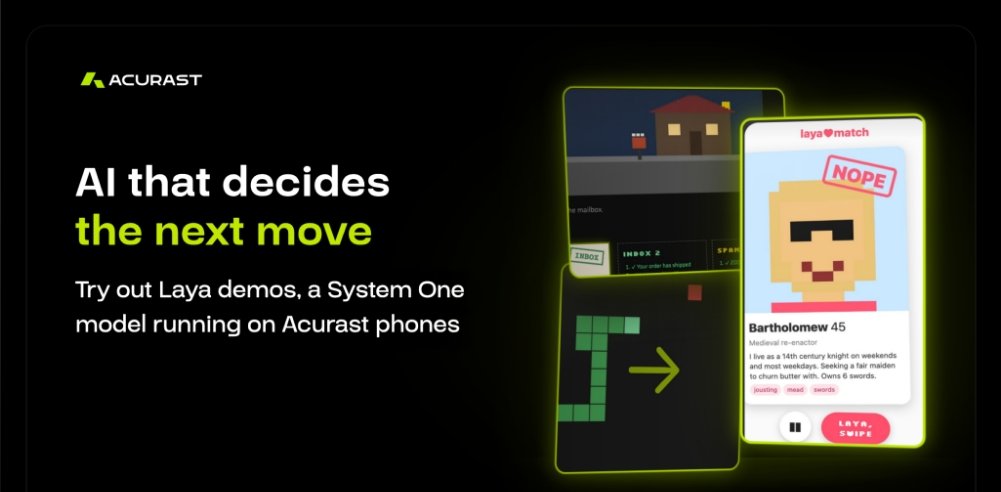
Laya demos showcase decision-making models running on the CPUs of Android phones handling tasks like email categorization, chat moderation, and screening for prompt injection.
Acurast notes that each decision takes approximately 0.2–1 second. You can test it at and see which device is processing your request. The development team also acknowledges certain limitations: classification errors can occur, and queues may grow longer when the volume of requests exceeds a phone’s processing capacity.
The trust challenge
If a phone belongs to someone else, how can you be sure that the device executing your task is legitimate? Acurast employs hardware-based attestation (Google Key Attestation and Apple App Attest) and monitors for revoked credentials, removing compromised or invalid devices from the pool of those eligible to receive tasks and earn rewards. @Acurast
Verification is therefore continuous, rather than occurring only when a device first joins the network. That said, the security model remains dependent on the hardware manufacturers and platform providers.
The role of ACU
ACU serves several defined functions: covering network fees, incentivizing the provision of computing power, staking, and governance. The most notable mechanism is "Staked Compute": providers lock up tokens to commit a specific amount of computing power, while ACU holders who lack hardware can delegate their tokens to these providers.
Benchmarks and "heartbeat" signals monitor capacity and availability, ensuring providers have an economic incentive to honor their commitments.
It is worth noting that the tokenomics include an annual inflation rate of 5%, with 70% of that allocated to the Staked Compute Pool. Therefore, staking rewards should not be confused with revenue generated from customers paying for computing services. While incentives can help build supply, it is the return of actual customers that truly validates the value of that supply.
Key metrics to track:
•Number of paid tasks and the rate of returning developers
•Cost per successfully completed task
•Stability under sustained load
•Growth in usage relative to token-based incentives
These metrics offer a much more meaningful picture than simply counting the number of registered devices.
How to get started?
The "Cloud Rebellion" program allows you to explore the ecosystem by completing tasks, deploying applications, and onboarding a supported device to the network. @Acurast
You earn "MIST" points which are distinct from ACU tokens. My advice: try out the demo and use a spare device before making any further investments.
An AI just beat me at Snake.
Seriously. It was running on a single Android phone, making decisions in about 0.2 to 1 second. No data center needed.
The model is Laya, an open “System One” decision model from ConvAI Innovations, running on @Acurast decentralized phone network.
What makes this different from a typical AI demo?
Laya doesn’t generate text. It makes decisions.
Picking an option. Sorting spam from real messages. Blocking prompt injections. Even playing Snake. All in under a second.
And it’s not running on some huge GPU cluster. Just one phone, costing less than 1 $ACU a day.
There are 9 live demos right now. A mail sorter, a chat moderator, a newsroom that catches clickbait, a prompt injection guard and even a “Swipe for me” dating style demo.
Different use cases, same open-source model, all running on phones.
It got me thinking.
We keep hearing that AI needs more GPUs and bigger data centers. But does every AI task really need that much computing power?
What if our phones could handle the quick decisions, like routing, filtering and moderation. While the heavy work stays in the cloud?
That’s what Acurast is exploring with this demo.
And honestly, this feels like a more practical use case for DePIN than most “run a node and earn” projects I’ve seen.
So, what do you think? Is this where edge AI is heading, or is it just a cool party trick?
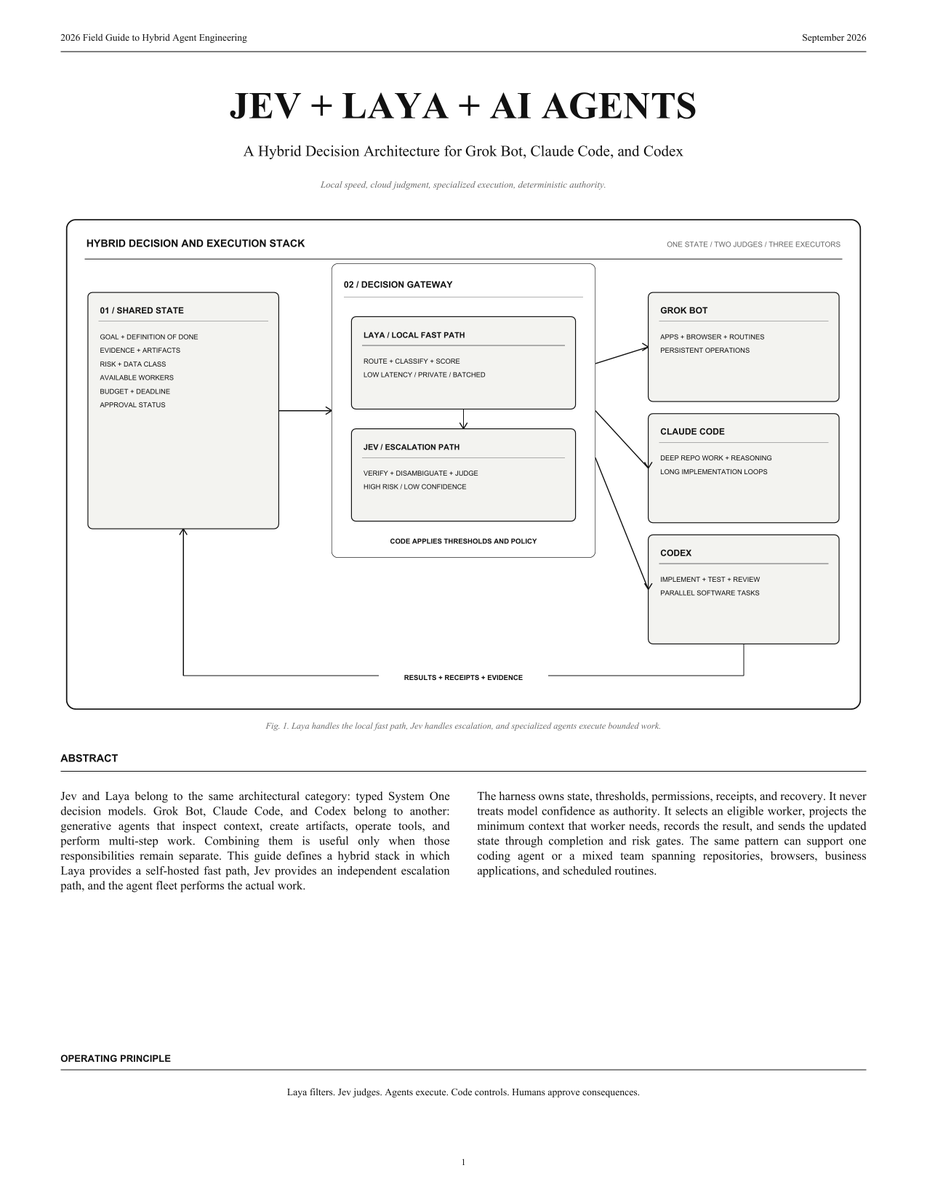
Jev + Laya + any AI agent is an absolutely insane stack
Jev became one of the most talked-about AI releases almost overnight, but most people still have no idea how to use it beyond isolated demos - especially together with Laya, Grok Bot, Claude Code and Codex
So I mapped the complete architecture into a 12-page guide explaining how to combine all of them into one decision-and-execution system - and the result is genuinely ridiculous:
step 1 → stop asking one LLM to do five different jobs: state, judgment, generation, execution and authority should be separate layers
step 2 → use Jev as the escalation layer: it handles difficult routing, evidence verification, completion checks and high-consequence decisions through typed answers
step 3 → use Laya as the local fast path: it handles frequent classification, scoring, filtering and worker selection without sending every decision to a cloud model
step 4 → put both behind one decision gateway: Laya and Jev can accept similar choice, score and yes-or-no questions, but their confidence values need separate thresholds
step 5 → keep project state outside the agents: goals, artifacts, evidence, gaps, risks, budgets and approvals become the shared source of truth
step 6 → build the worker menu before asking a model to choose: only include agents that exist, are available, have the required tools and are allowed to access the data
step 7 → give every executor a different job: Grok Bot handles apps, browsers and routines; Claude Code handles deep repository work; Codex handles implementation, testing and review
step 8 → turn every assignment into a bounded packet: one owner, one objective, approved inputs, expected artifacts, forbidden actions and an exact definition of done
step 9 → run the hybrid decision loop: Laya answers locally first, Jev receives uncertain or high-risk cases, and a human reviews consequential disagreements
step 10 → never average confidence blindly: if Laya and Jev disagree, preserve both distributions, inspect the evidence and route the case through an explicit review policy
step 11 → gate effects instead of tool names: reading, searching, testing and drafting can run automatically; publishing, deploying, spending, deleting and exposing secrets still require approval
step 12 → test the whole system before giving it autonomy: run shadow mode, measure disagreements, inject failures, test rollback and automate only the safest branches first
the result: Laya filters routine decisions, Jev judges difficult boundaries, Grok Bot, Claude Code and Codex execute the work, deterministic code controls the system and you approve the consequences
Save this, then send the complete 12-page Jev + Laya + AI Agents guide to your Claude Code or Codex instance and build the stack ↓
I finally tried @Acurast Laya demo and I get it now.
For weeks I kept seeing “phones running AI” and thought okay cool concept, but what does that actually mean?
Then I played the Snake demo. An AI model, running on a single Android phone, making a move every 0.2-1 second.
No data center. No GPU cluster. Just a phone...!
And it’s not just Snake. There’s a mail sorter (90% accuracy), a chat moderator, a prompt injection guard, even a “Swipe for me” dating-style demo. All powered by the same open-source model from ConvAI Innovations.
Here’s what clicked for me: we keep saying AI needs more GPUs and bigger data centers.
But what if most everyday decisions spam filtering, content moderation, quick routing
don’t need that?
What if your phone could handle the “fast decision” layer while the heavy stuff stays in the cloud?
That’s what Acurast is testing with Laya. And honestly? It’s the first DePIN use case that actually made sense to me.
Not run a node and hope for rewards. Actual AI decisions, running on actual phones, for real use cases.
What do you think ? Is this the future of edge AI or just a cool demo?
Here’s :
Code : ansk5e
🆕 Guía de Laya.cpp (Alternativa a JEV)
✅ Modelo de IA muy pequeñito (< 1GB)
✅ Posibilidad de uso en local
✅ Laya multilingual (incluido español)
✅ Rendimiento: ~230ms (Jev) vs ~33ms (Laya)
✅ Open Source (y gratis)
Eikos está aberto (MIT).
Modelos de decisão (System One) de 4B e 27B: decidem numa única passada e dizem a probabilidade de cada opção.
• 27B: 82,9% no JevBench hard (Jev: 73,0)
• 2,4% de erro com ≥90% de certeza (Jev: 5,9%)
• 64k de contexto
Mesmos itens, mesma pontuação: 8 baterias contra o Jev e a Laya.
Pesos, dataset e código:
해커뉴스에서 난리 난 'Ollaya( 역대급인 이유:
1. "Ollama의 편안함을 의사결정 모델로"
- 복잡한 파이썬 환경이나 CUDA 세팅 필요 없음.
- 터미널에 `ollaya run laya` 딱 한 줄만 치면 Mac GPU(MLX)나 CPU에서 초경량 의사결정 모델이 0.1초 만에 실행됨.
2. 쓸데없는 텍스트 생성 0% (몇 밀리초 만에 정밀 확률 반환)
- 무거운 LLM처럼 문장을 주절주절 뱉지 않음.
- 고객 메시지 하나를 넣으면 단 1번의 연산으로 [환불 요청: 90%, 분노 지수: 1.76/3, 이탈 위험: 61%] 같은 가중치 확률을 수십 밀리초 만에 뱉어냄.
3. 기존 Jev / TypeSafe 코드 100% 호환
- 기존에 짜둔 Jev 코드가 있다면 환경변수(BASE_URL) 하나만 로컬 포트로 바꾸면 끝.
- 클라우드 유료 결제하던 비용이 '완전 0원'으로 떨어짐.
4. Cursor & Claude Code 전용 MCP 공식 지원
- `claude mcp add ollaya -- ollaya mcp` 명령어 하나로 내 AI 코딩 에이전트에 직결 가능.
- 에이전트가 조건 분기나 코드 분류를 판단할 때 비싼 최상위 모델을 안 쓰고 로컬 Ollaya를 호출해 API 비용 90% 이상 세이브.
5. 어디에 써먹을 수 있는가?
① 고객 문의 자동 분류 및 담당자 자동 라우팅
② AI 에이전트의 다음 행동(Tool Call) 초고속 분기 판단
③ 스팸 메시지, 악성 댓글, 비정상 결제 실시간 필터링
④ 문서/이메일 긴급도 판별 및 태깅 자동화
비싼 LLM 호출하느라 에이전트 루프 비용 터지던 분들은 무조건 저장해두시길.
🔗 공식 사이트:
🔗 깃허브:
Me piden por todos lados que meta Jev en gentle-ai.
Lo probé con código real, junto con Laya y Kev.
Uno me dejó la GPU al 99%. Otro acertó menos que mi heurística. Y el que mejor anduvo no era ninguno de los que me pedían.
Video en comentarios 👇
Why put an AI guard at the entrance? Because Agents read both user instructions and untrusted content.
If an email contains a hidden command, the Agent may treat it as part of the task. That becomes dangerous once tools or business data are involved.
@Acurast built Jailbreak the Guard to test this problem:
• Submit a prompt
• Laya decides whether to allow or block it
• The model identifies the likely attack type
• The decision runs on an Android phone in the Acurast network
It will not catch every adversarial prompt. But as a first filter before permissions and tool calls, this is a practical use of decentralized compute.
The real test is whether developers keep deploying workloads and paying for them with $ACU.
#Acurast #AI #DePIN
🚀 Rapid-MLX 0.15.2 is out! The headline: Native System One support on Apple Silicon!
System One isn't just another chat endpoint. It’s a dedicated local decision server for apps that need fast, structured answers: yes/no judgments, classification, routing, and candidate ranking.
What's new in Rapid-MLX:
⚡️ CLM-8B — a native MLX Qwen3-8B encoder with contrastive projection heads
🧠 Laya — an ~807 MiB low-latency backend
📊 Typed endpoints: /v1/systemone (noul, choice, score) & /v1/rank
🛡️ Enterprise-ready: API keys, bounded concurrency, and state/action caching
Performance on M3 Ultra CPU:
• Laya: warm 3-question request in ~170ms; single decision in ~52ms.
• CLM-8B: cached decisions in <1ms server time.
Give it a try:
What if your next AI model runs on a phone, not a data center?
System One models handle decisions like spam detection, moderation, routing, and prompt safety.
Laya puts these workloads on phones through Acurast’s decentralized cloud.
~0.2s decisions. Open model. Private by design.
AI doesn’t always need to scale up. Sometimes, it scales out.
Read the full story 👇