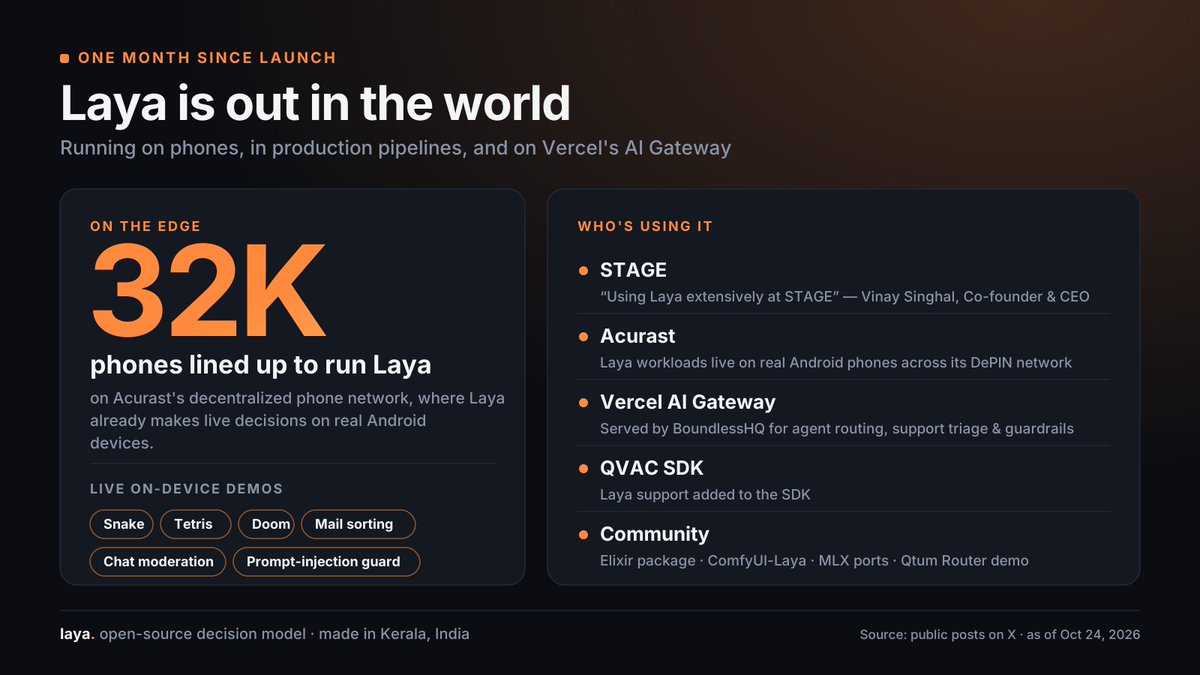
Seen on X

What people are building with Laya.

Demos, games, ports and benchmarks posted on X, picked by hand. Each one links back to the original post and, where there is one, to the project in the directory.

Octop 1.0.2 uses Laya to route tools, skills and teammates

Your team's AI can now live on more than one machine, and every person gets their own. It's Octop, our open-source, self-hosted AI workspace, where each person has separate agents, memory and workspace. The new 1.0.2 is about the team side, from how agents work together to where the work runs. Team mode lets you describe the outcome once, and several agents figure out who does what before returning one answer. Cross-machine collaboration lets your laptop use another machine's experts, files and environment. Nothing moves, including conversations. We also support decision models like Jev and Laya. Before a task reaches the main model, they screen which tools, skills and teammates are actually relevant, which cuts token use as the team and the toolset grow. Use octop run to start the 10k-star project:

♥ 153↻ 1510k viewsView on X

Unsloth fine-tunes Laya and small LLMs into typed-decision models

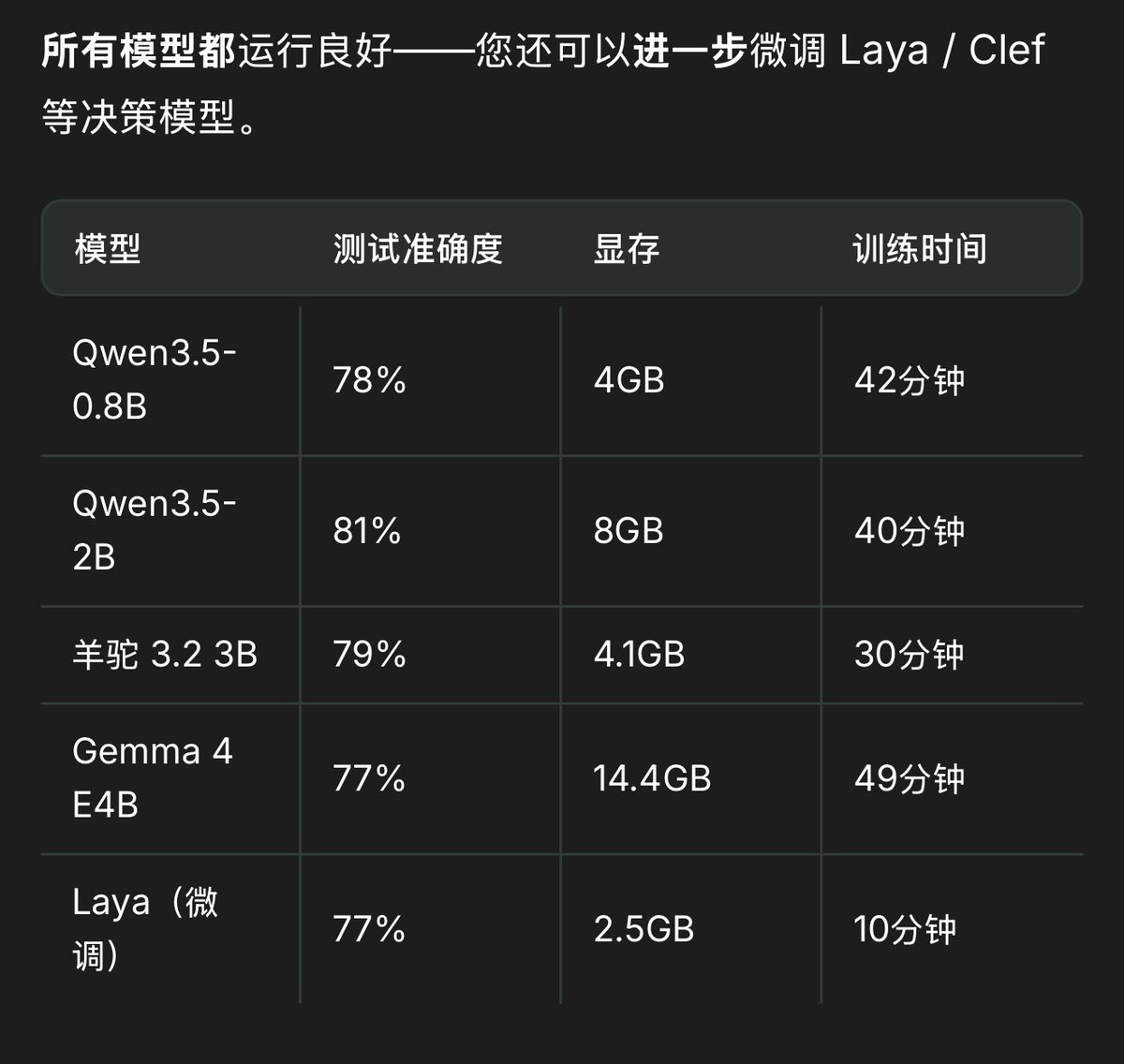
💥卧槽!2.5GB 就能训出自己的本地决策模型!任意小 LLM 直接改造成 Jev/Laya/Clef 风格的决策引擎,准确率从随机水平 30% 左右直接拉到 77-78% ! 核心亮点: 🔹Laya 继续微调只要 2.5GB 显存、约 10 分钟,测试准确率 77% 🔹Qwen3.5-0.8B 聚合准确率从 20.7% → 74.3%,4GB 显存即可(typed-decisions 36%→73%,BANKING77 7%→74%,CLINC150 19%→76%) 🔹Clef head + LoRA(QLoRA),一次 epoch 就能把下游准确率从 30-37% 打到最高 78% 🔹支持 Qwen / Gemma / Llama 等任意文本或视觉模型,数据全程本地,可导出 GGUF、通过 Decision API / llama.cpp 直接服务,返回带校准概率的选项 上手只需 4 步: 1️⃣更新 Unsloth Desktop,或 pip install --upgrade unsloth 2️⃣打开 Train 页,选模型(如 unsloth/Qwen3.5-4B 或直接微调 Laya),Train as 设为 Decision model 3️⃣推荐参数:epochs=2、LoRA rank=16、lr=2e-4,加载 typed-decisions 等数据集后开训 4️⃣训完一键丢进 Decision API 测试/部署,或代码里用 FastDecisionModel + DecisionTrainer 复现 GitHub:
文档: 本地决策模型终于不再是大厂专属了。 #Unsloth #DecisionModel #LocalAI #LLM #FineTuning #开源 #QLoRA #本地部署 #决策模型 #Laya #Clef

♥ 152↻ 3315.9k viewsView on X

Local Laya beats Jev in Snake with 86.5 decisions per second

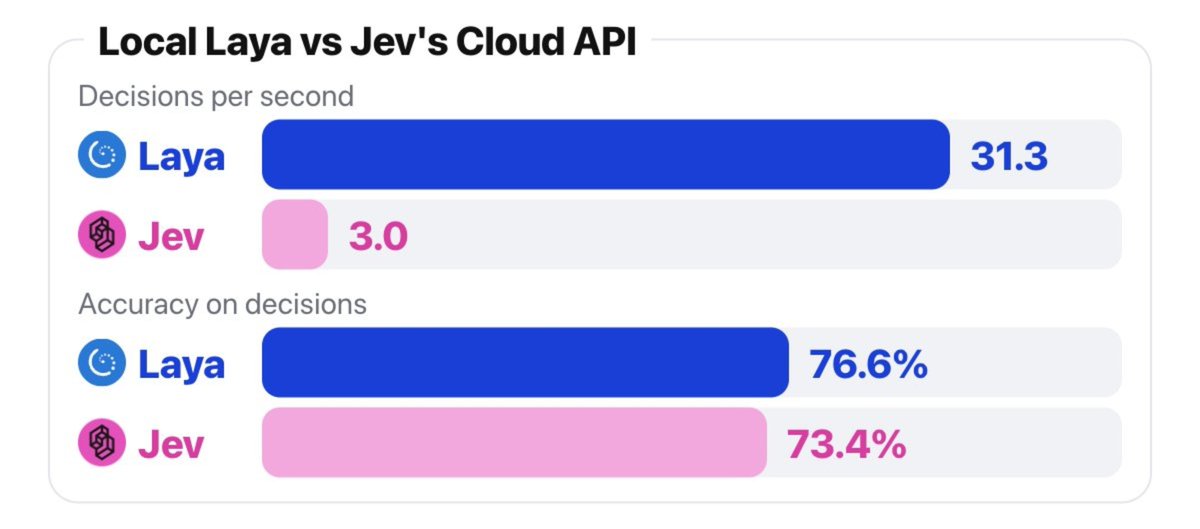
The open-source local version of Laya crushes Jev in response speed! On the left is Laya, a local 421M open-source decision model. On the right is Jev 1.13.0, running through a cloud API. Same Snake game, same typed decisions, and the same 30-second free run: - Laya: Score 46, Length 52, 86.5 decisions/sec - Jev: Score 1, Length 7, 3.2 decisions/sec - In a real test on an M5 Pro, median latency was 15.3ms locally versus 298.1ms in the cloud, so nearly 20x faster. Laya uses around 1GB of memory, responds in milliseconds, and doesn’t depend on a network connection. While Jev waits for a cloud round-trip at every step, Laya makes each decision instantly on-device.

♥ 151↻ 2424.5k viewsView on X

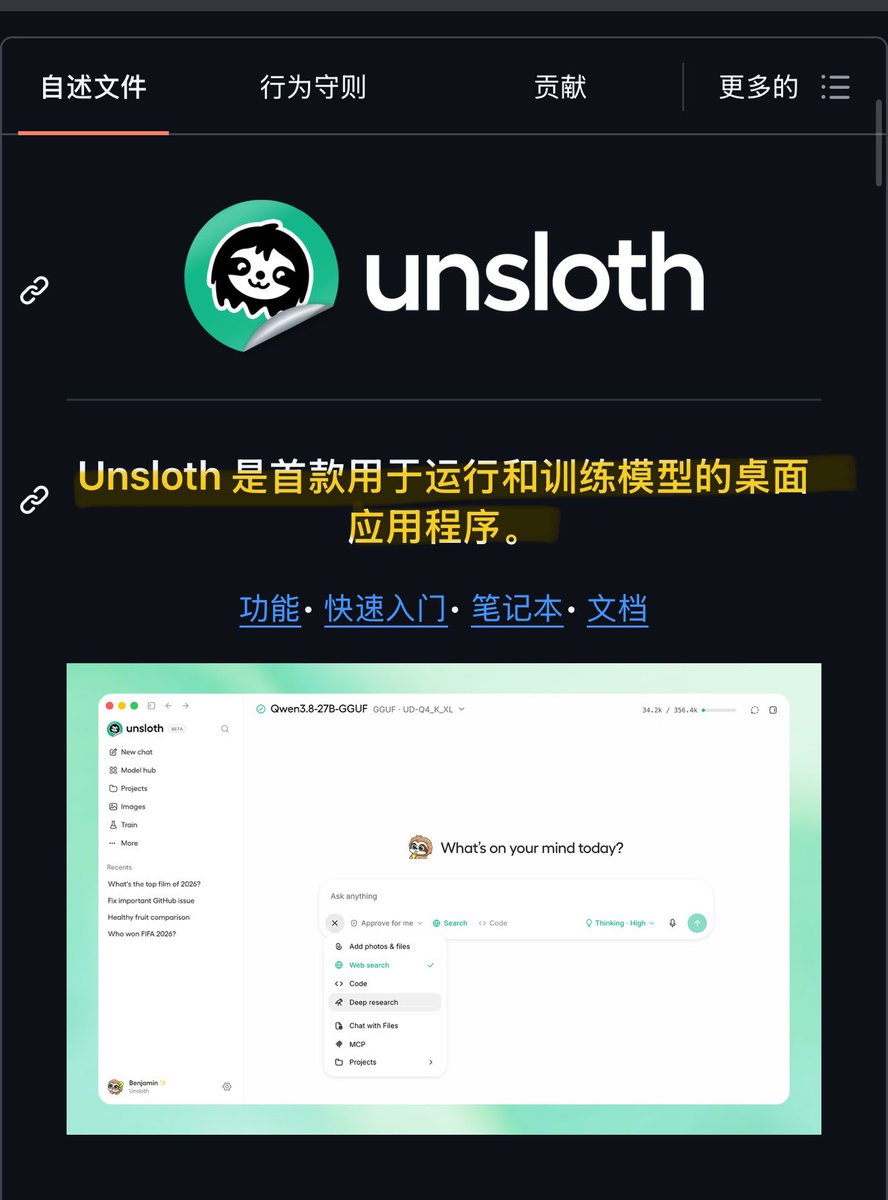
Unsloth Desktop serves Laya locally with a Jev-compatible API

🔥好厉害!本地4GB内存也能把 Laya 跑在自己电脑上了,不是聊天,是秒出结论! 你还用 70B 大模型做工单分流、邮件过滤、紧急度打分了,这已经落伍了。 
Unsloth 刚把开源决策模型 Laya(Jev 平替)接到 Desktop: 🔹默认多语言模型仅 678MB,最低 4GB RAM 🔹CPU 也能跑,Win / Mac / Linux / GPU 全覆盖 🔹数据不出本机,首包加载后多数 CPU 1 秒内出结果 🔹一次请求可同时问最多 64 个问题:是/否、选项、评分,还带校准概率 🔹直接开 Jev 兼容 API,现有集成改个地址就能用 3 步丝滑跑通: 1️⃣装 Unsloth Desktop
Mac/Linux:curl -fsSL | sh
Windows:irm | iex 2️⃣打开 设置 → API → Decision API,打开 Serve requests,下载默认 678MB 模型 3️⃣请求打到 填 laya 工单路由、退款识别、安全告警分级、Agent 路由,这种“要结论不要散文”的场景,才是它该待的位置。 文档:
仓库: #Laya #Unsloth #本地AI #DecisionModel #Jev #开源 #边缘AI #4GBRAM

♥ 151↻ 3030.1k viewsView on X

Doom benchmark compares Laya with Jev and other decision models

HOLY SH*T! Someone gave the same Doom level to four AI models and let them fight. Jev wasn’t shown pixels and received no Doom-specific training. A Python adapter described the visible enemies, health and ammo, then the models had to choose one action: move left, move right or fire. Across eight seeds, the results looked like this: > Jev: 5.63 average kills > Qwen 3.5 4B: 3.63 > Laya: 1.25 > ModernCE: 1.25 Jev made roughly five decisions per second while the game continued running. This is a much better explanation of Jev than another benchmark table. It doesn’t need to write a strategy, narrate its reasoning or roleplay as a Doom player. It reads the current state, returns a probability for each valid action and lets ordinary code execute the decision. See enemy -> Measure risk -> Choose action -> Repeat. That same loop can route an agent, approve a tool call, detect failure or decide when an expensive LLM is actually needed. Jev isn’t interesting because it can play Doom. It’s interesting because software can finally ask AI for a decision without paying it to write an essay first. I mapped 12 real decision systems inside the article below.

♥ 148↻ 1416.8k viewsView on X

Laya runs email classification and toxicity detection on Android CPUs

AI × DePIN doesn't always need massive GPU clusters One thing that caught my attention about @Acurast is Laya, an open-source model designed to run decision-making tasks directly on Android phone CPUs According to Acurast, some tasks can run in around 0.2–1 second, including email classification and toxicity detection The idea is simple: not every AI workload needs expensive infrastructure. Some can run on hardware we already have in our pockets Acurast also uses TEE to help isolate execution and make computation more verifiable But there's one thing worth keeping in mind Having hundreds of thousands of devices connected doesn't automatically mean there's strong demand for their computing power The real question is whether developers will deploy useful workloads and pay to use the network at scale For me, that's what will matter most for the long-term potential of AI × DePIN: not just how many devices are connected, but how much useful work they actually perform DYOR.

♥ 148↻ 26.2k viewsView on X

Local Laya plays Tetris 11 times faster than cloud Jev

النموذج المحلي Laya يكتسح نموذج Jev السحابي في مواجهة حية لتشغيل لعبة Tetris تم بناؤها بوساطة Grok 4.7! 💥👇 نموذج open-weights من فئة (System One) استطاع تفوق كامل لاتخاذ القرارات بسرعة مرعبة أسرع 11 مرة، وكل ذلك بجلسة تشغيل محلي بالكامل على MacBook Air بذاكرة 16GB فقط! زمن استجابة شبه معدوم (Zero Latency): معالجة فائقة السرعة تتفوق على استجابات السحابة والـ APIs. سيادة وكفاءة: أداء مالي وعملياتي دون استهلاك اشتراكات أو سيرفرات خارجية.

♥ 146↻ 1626.6k viewsView on X

Acurast phones run nine Laya demos, from games to chat moderation

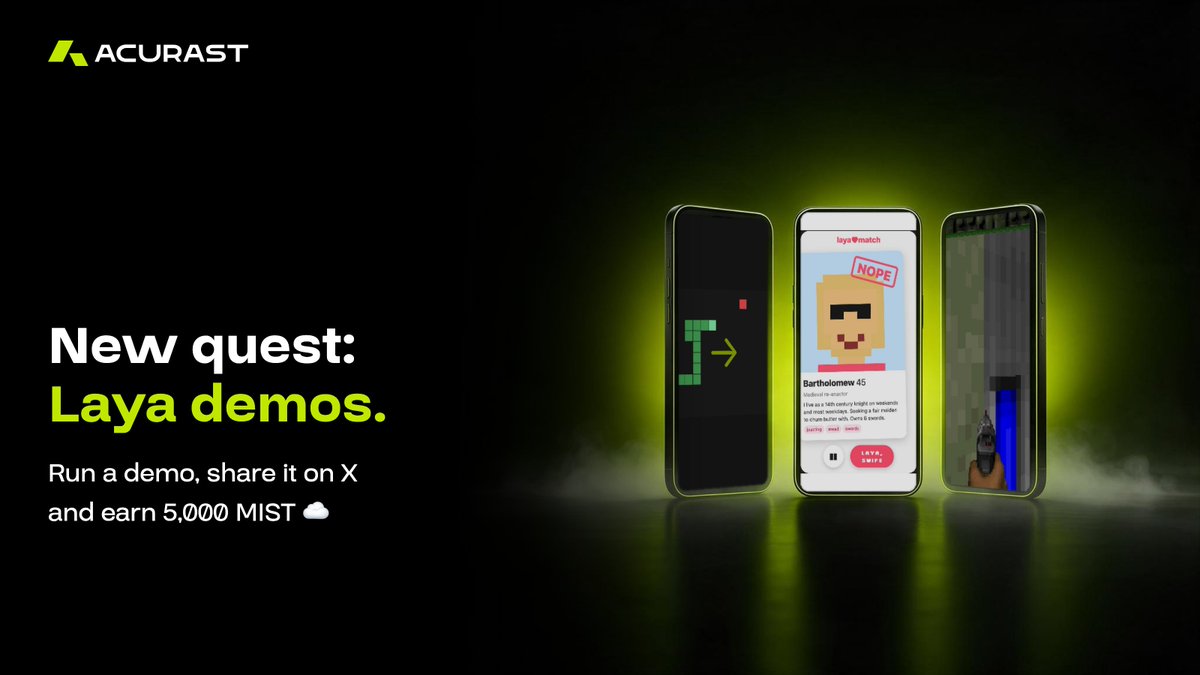
What if an AI running on a phone decided your next move? Meet Laya, an AI running on Acurast phones. Explore 9 live demos, from Snake, Tetris & Doom to AI chat moderation and prompt-injection defense. No account. No sign-up. Just experiment, play, and see what’s possible. Played around? Turn it into 5,000 MIST ☁️ points with our new Laya Quest: share your experience on X, sign in to the Cloud Rebellion and submit your post’s URL. Try out the demos: Complete the quest:

♥ 143↻ 4325.3k viewsView on X

Acurast runs Laya decision demos on Android phones

最近看到 @Acurast 的新动态,我觉得这个项目值得重新关注一下 10 月 2 日,Acurast 展示了 Laya AI 模型在真实手机上运行的 9 个演示,包括贪吃蛇、邮件分类、聊天内容审核,甚至还有 AI 提示词攻击检测 这些任务看起来不算复杂,但重点在于,AI 做出的判断并不是由传统数据中心完成,而是交给 Acurast 网络中的 Android 手机运行。官方展示中,部分手机完成一次简单决策只需要约 0.2–1 秒 这让我觉得,AI × DePIN 真正值得关注的地方,不只是把闲置手机连接起来,而是这些设备到底能不能承担实际的计算任务 而且 7 号 Acurast 又发布了关于 Processor 持续验证的技术文章。设备接入网络只是第一步,如何确认设备真实可信、运行环境没有被篡改,同样是去中心化算力能不能走远的关键 当然,几个演示还不能证明商业模式已经跑通。后续我更关注真实任务量、开发者使用情况,以及网络有没有持续的付费需求 如果手机算力真的能在隐私敏感的 AI 决策、内容审核和 Agent 服务中找到自己的位置,Acurast 的想象空间就不只是 DePIN 了 官网:

♥ 142↻ 014.7k viewsView on X

Keel and jev-opus add Laya decision layers to coding agents

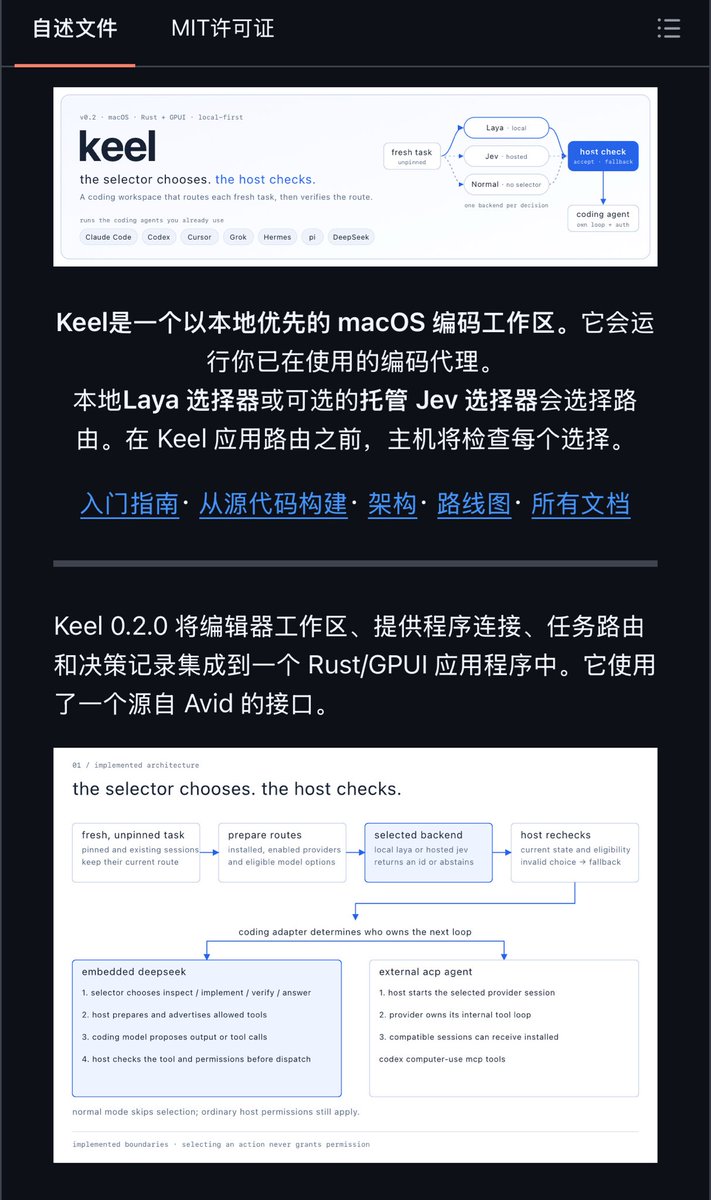
🔥别再让 Opus 5.5 全程满血烧钱了!Jev 当裁判、Opus 干硬活,成本和时间直接砍掉约 80%!现在还不搭建,才是真看不懂! 核心亮点 🔹Opus 只负责难推理;Jev 从 harness 预先准备好的选项里做选择并校验 🔹动态调 effort(low→max),用 per-message 声明改力度,不打碎 prompt cache 🔹失败自动升档、通过自动降档,工具挂了先选恢复路径,不全量重跑 🔹先筛项目笔记再灌上下文,简单任务分流给更快 worker 🔹先跑聚焦检查,再上完整测试套件 两条上手路径(选一条就行) A. 最快:给 Claude Code 加上 Jev 决策层 仓库: 1️⃣准备 Node ≥ 22.18 + Claude Code 2.1.280+(先 claude auth login) 2️⃣npm install -g jev-opus 3️⃣jev-opus init(填 TypeSafe / OpenRouter 的 Jev key;没有也能用本地启发式) 4️⃣jev-opus doctor 体检 5️⃣jev-opus claude 启动,在 /model 选 Opus 5.5 · Jev 6️⃣开始干活。想无头跑任务:jev-opus "fix the failing tests" B. 完整 harness:本地工作区 + 决策层 仓库: 工程说明: 1️⃣Apple Silicon + macOS 15+ 2️⃣git clone && cd keel 3️⃣bash scripts/build-laya-assets.sh 4️⃣cargo build -p keel --bin keel --release 5️⃣打开 Keel,选 Jev / Local Laya / Normal 6️⃣接上你已有的 Claude Code / Codex / Cursor 等 agent,把决策交给 Jev,推理交给 Opus 原则就一句: harness 准备选项并校验,Jev 做窄决策,Opus 5.5 只在值得烧的地方满血。 #Jev #Opus55 #ClaudeCode #AgentHarness #BuildInPublic #AIEngineering #PromptCache #LLMAgents

♥ 138↻ 2146.3k viewsView on X

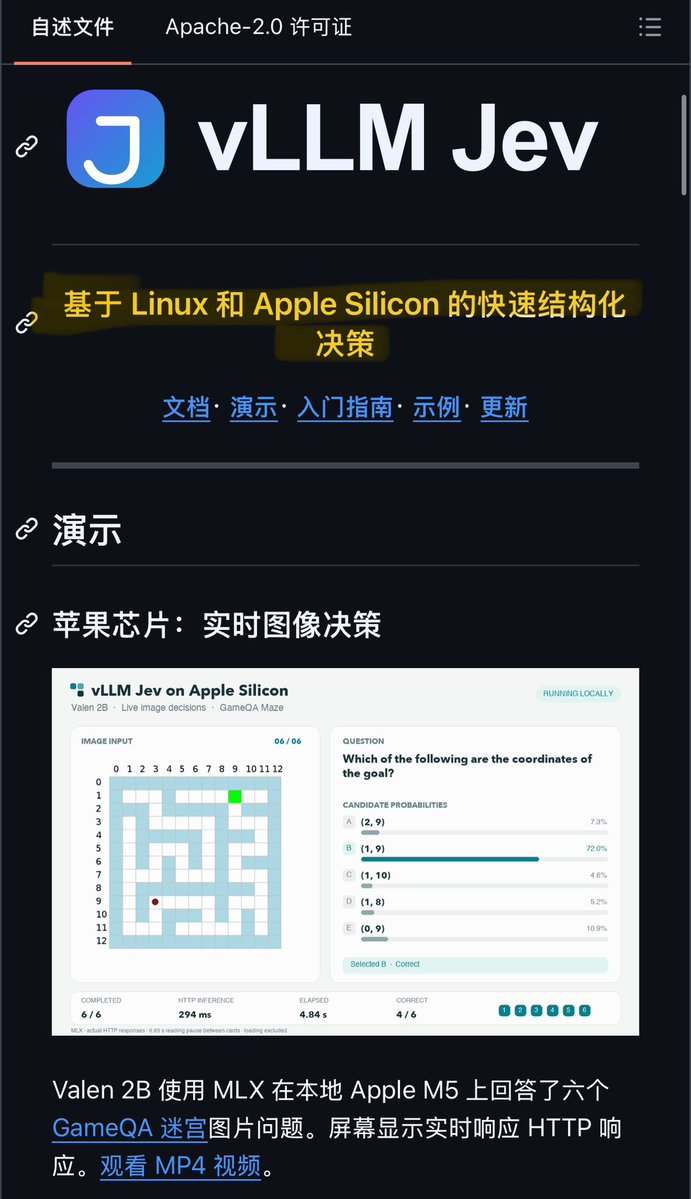
vllm-jev adds a server for fast typed decisions, including Laya models

😱什么?!单次推理时间从 600ms 暴降至 50ms,把 Jev 决策压成眨眼级! 
开源引擎 vllm-jev 把 System One 推理从一次 600ms 砍到约 50ms,官方基准常见 5×–50×,并发最高约 43×,候选答案 + 概率,一次前向给出,不生成长文本。 核心亮点 🔹原生挂上 vLLM:调度、批处理、KV cache、编译全吃到 🔹已支持多模态 + Laya 全系;Valen / vjev 可图文同接口决策 🔹Linux NVIDIA 即开即用;Apple Silicon 已有一键脚本,Mac 部署在路上 🔹输出是 typed 决策(Choice / Noul / Score)+ 概率,适合路由、客服、游戏、产品迭代 3 步上手 1️⃣git clone && cd vllm-jev && uv pip install . 2️⃣vllm-jev serve ZefanCai/Open-Jev-2B(首次自动拉模型,默认 3️⃣POST /v1/systemone:塞 state + questions,拿回 choice 和 probabilities Mac:source scripts/install_mac.sh 再 vllm-jev serve Valen-Team/Valen-Preview-0923。 仓库: #jev #vLLM #LLM #AI进化生活 #howto #开源 #多模态

♥ 138↻ 2920.3k viewsView on X

Acurast runs a Laya-powered mail sorter for spam and phishing

A few days ago hackers stole $6.3B from Binance. Now the scammers are moving in. Fake “compensation” emails. Fake support agents in your DMs. “Verify your wallet to claim your refund.” Think you can write one convincing enough to fool an AI? In our Laya mail sorter, a System One model on a single phone in the Acurast network decides: inbox, spam or phishing. Try to get yours past it 👇 Learn more:

♥ 135↻ 4613.1k viewsView on X

A fine-tuned Qwen-0.6B model challenges Laya on Jev benchmarks

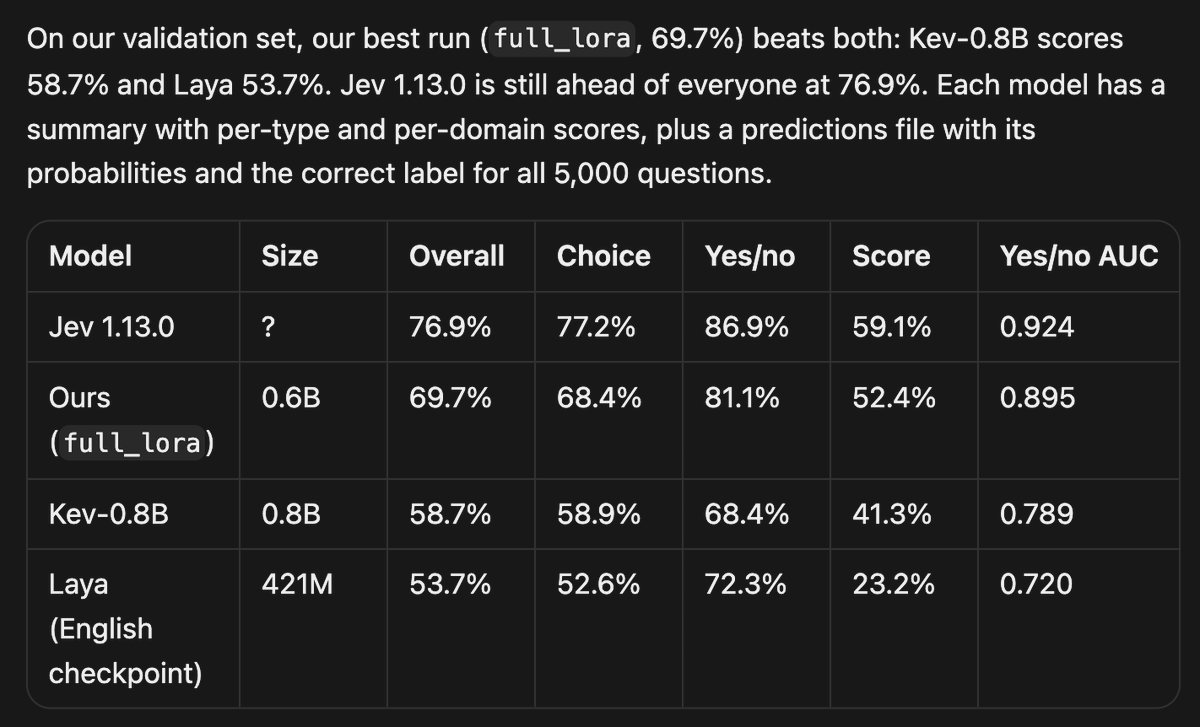
The jev decision benchmarks are so misleading Anyone can easily add more jev-bench like data, train for longer, and beat out every model in the <1B category. I trained a small self-attention head on a qwen-0.6B model on a custom dataset, and after 1 epoch of training it beats out Kev and Laya. My dataset contained more finance-QA, spatial reasoning where those models are weak. On existing benchmarks like jev-bench, these models outperform my silly model by 5%. This proves to me that benchmarks are being gamed right now.

♥ 133↻ 67k viewsView on X

Laya demos show phone-based game AI, email classification, and moderation

What if AI didn’t need a data center to make a decision? Most AI conversations focus on larger models, more GPUs, and bigger infrastructure. But @Acurast is exploring a different question: how much useful AI work can run on phones people already own? Meet Laya, a decision-making model running on Acurast’s decentralized smartphone network. Its nine live demos go beyond gaming. Snake, Tetris, and Doom show how AI can choose actions, while email classification, chat moderation, and prompt-injection screening point toward practical software applications. That distinction matters. Not every AI task needs a massive model generating paragraphs. Some tasks need fast, structured decisions and those may be suitable for smaller models running on everyday hardware. Acurast’s approach connects these workloads to a distributed compute network rather than relying exclusively on centralized infrastructure. Of course, real-world adoption will still depend on accuracy, latency, reliability, and cost. I think the interesting question isn’t whether a phone can run AI. It’s which useful AI workloads can a network of phones handle consistently at scale? You can experiment with Laya’s demos at There’s also a Cloud Rebellion quest offering 5,000 MIST points for sharing your experience on X and submitting the post URL. MIST are campaign points, not the ACU token.

♥ 131↻ 02.7k viewsView on X

Acurast demonstrates Laya for email classification, chat moderation, and game decisions on phones

What if the next wave of AI infrastructure doesn’t need more data centers, but makes better use of the smartphones we already have? That’s the opportunity @Acurast is exploring at the intersection of AI and DePIN. Acurast’s Mainnet went live on January 20, 2026. Its official website now reports 339,000+ onboarded phones, 1.1B+ on-chain transactions, and 709K+ compute deployments. The technical approach is what makes this interesting: → Distributed compute: Smartphones contribute processing power to a global network instead of relying entirely on centralized cloud providers. → Verifiable execution: Hardware-backed Trusted Execution Environments (TEEs) and attestation help verify the devices running workloads. → Real AI use cases: Acurast has demonstrated Laya, a lightweight AI model running on phones for tasks like email classification, chat moderation, and game decisions. And $ACU has a functional role beyond speculation: network fees, compute incentives, staking, and governance help coordinate the ecosystem. The opportunity isn’t replacing GPUs for every AI workload. It’s finding the right tasks for distributed mobile compute, especially lightweight inference where privacy and accessibility matter. My view: Acurast’s next test is turning impressive network scale into sustained developer demand and useful workloads. That’s what I’ll be watching as AI × DePIN evolves. 📋 #Acurast #DePIN #AI #ACU

♥ 127↻ 12.6k viewsView on X

A DGX Spark prototype runs Laya with Qwen and Hermes Agent

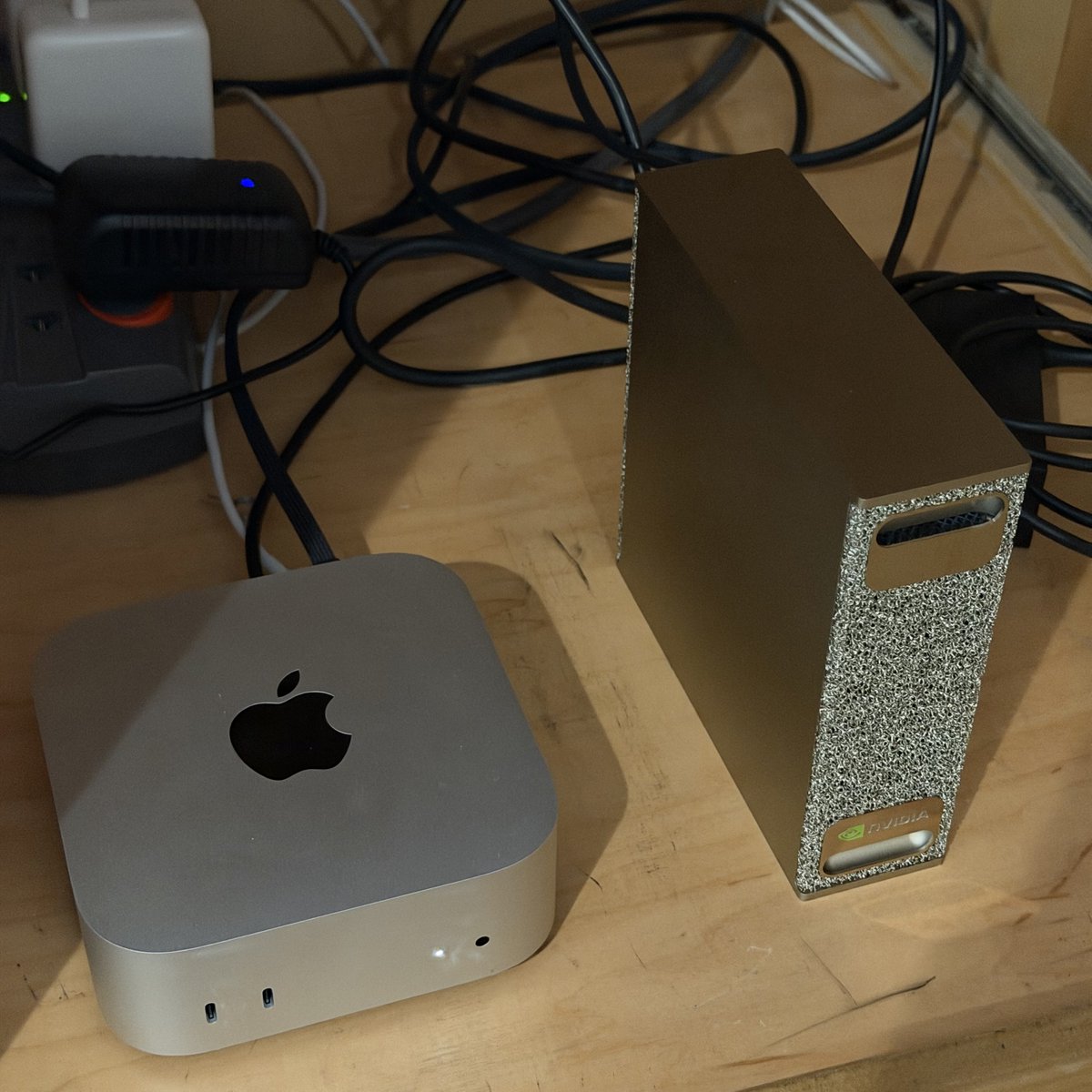
The DGX Spark in its new closet home. Current build: - Qwen 3.8 Flash Next (@MiaAI_lab recipe) - two concurrent requests - Laya (system 1 decision model, decision models change EVERYTHING and EVERY workflow needs it.) - Hermes Agent as the harness This is a prototype for a customer who will be running a two Spark recipe. Working great so far and fits nicely in memory! About 70 tok/s for Qwen. Feel like maybe I could use a 2nd one. 😉

♥ 127↻ 510.2k viewsView on X

Acurast runs Laya-powered Doom decisions across Android phones worldwide

Can it run Doom?” is old news. Now it’s “Can it play Doom?” An AI deciding every step it takes, live on Android phones all around the world on the Acurast network. One open model, one phone per move, 0.7 s per decision. Argentina, Japan, wherever the network is. Decisions, decentralized. Try it out, explore the other demos, or create your own Laya instance 👉

♥ 115↻ 2725.7k viewsView on X

Arbiter runs Laya decisions on Spark and M2 Max through a Jev-compatible API

I put a second model next to the LLM on my Spark. It does not write text. You send it a state and typed questions, and it answers every one of them in a single forward pass, each with a probability. Yes it is Jev the open source version. It can be installed on macOS, any Nvidia gpu or dgx sparks One question takes 20.6 ms on the Spark and 30.3 ms on my M2 Max. Fifty questions in one call take 157 ms. The model is Laya, an open 421M encoder. I serve it through a Jev-compatible API and called the repo arbiter.

♥ 110↻ 1415.2k viewsView on X

Acurast runs Laya autonomously through a Snake game on phone nodes

这条贪吃蛇,我只按了一下开始。 后面79次怎么走,全是AI自己决定的。 这段视频是我刚刚打开 @Acurast 的 Laya Demo,自己操作时录下来的。 点击开始以后,我没有再控制方向。贪吃蛇往上、往下还是转弯,都由运行在Acurast手机节点上的Laya实时判断。 页面会同步显示每个方向的概率和推理时间。视频里单次决策大约需要880—950毫秒,平均约0.9秒走一步。 刚开始我也觉得,不就是让AI玩个贪吃蛇吗? 但仔细想想,重点根本不在这个游戏。 它证明了普通手机节点确实可以执行AI推理任务,不是只挂在那里发心跳、领积分。 像邮件分类、内容审核、风险判断、Prompt Injection拦截、Agent任务路由,这类任务每次只需要完成一个小判断,可以拆开并行处理,也不一定非得塞进昂贵的GPU服务器。 这可能才是手机算力真正适合的位置。 Acurast目前已经接入32万+部手机。设备数量代表算力供给,但我更关心后面的需求: 有多少开发者愿意持续部署真实任务? 手机执行这些任务的稳定性和成本怎么样? 这些计算需求,最后能不能转化成对$ACU的长期使用需求? 一个Demo还不足以证明商业模式已经完全跑通。 但从“手机保持在线”走到“手机真正开始干活”,这个变化值得继续盯。 下一步我准备找一台没有钱包、没有重要资料的闲置手机,自己接入跑几天。 你觉得手机算力最先跑通的场景,会是Agent路由、内容审核,还是链上自动化?

♥ 110↻ 034.4k viewsView on X

Acurast runs the Laya decision model on distributed phone compute

中心发光,边缘呼吸:Acurast 如何用手机算力接住轻量 AI 国庆假期快乐! @Acurast × @EchoHunt_ai 活动第二周开始了。 这一段时间,中秋+国庆,假期让大家都变懒了吗? 看了下,当前榜单数据,参与账号只有106,奖励前150名,参与就能上榜,价值超2.6万U的 $ACU,你们确定不参与吗? 除了嘴撸,家里的闲置手机也挖起来 参与入口: 邀请码: ohvv5f 详细教程:见引用推文或推特其他KOL的教程 ════════════════ AI 走向轻量化已是明确趋势,而轻量化本就是 DePIN 的突出特征。Acurast 用手机算力做可验证计算,走AI+DePIN路线,无疑非常明智。 算力需求正在往边缘挪 过去几年,大模型训练把算力需求推到了数据中心极限。真正落地的应用却越来越不需要“更大的集群”。 垃圾邮件分类、内容审核、路由决策、实时风控、边缘推理,这些任务要的是低延迟、低成本和数据不出域,而不是再堆一张 H100。 小模型、量化模型、System 1 式决策模型因此抬头。算力不必集中在少数机房,也可以分布到靠近数据产生的地方。 ════════════════ 手机是现成的 DePIN 供给 DePIN 的逻辑与此同构。它不新建基础设施,而是把已经存在、已经通电、已经分散在全球的设备组织起来。 手机恰好是这类资源里数量最大、硬件安全能力又最被低估的一类。每年出货量以十亿计,更换周期不到三年,大量旧机躺在抽屉里,CPU 和安全飞地却还在。 Acurast 的做法,是把这些设备变成无服务器计算节点,而不是再去协调机房里的 GPU。 ════════════════ 可验证计算怎么跑起来 协议层面,开发者提交 Deployment,写明代码、调度和结果去向;链上 Matcher 按资源和信誉匹配 Processor。 执行发生在手机硬件支持的可信执行环境里。TEE 能证明代码未经篡改、运行在厂商认证的真实硬件上,同时让设备主人无法直接窥探输入和中间状态。 计算提供者安装 Processor 应用即可参与,日常手机用 Lite 模式,只在充电闲时贡献算力;闲置旧机可用 Core 模式锁定专供。 报酬以 ACU 结算。网络截止 2026 年三季度,接入约 32 万部手机,覆盖 175 个以上国家和地区,部署超过 67 万次,链上交易突破 10 亿笔,并支持安卓、iOS 与 Solana Mobile。 ════════════════ 轻量 AI 已经在手机上跑 这套设计特别适配轻量 AI 。近期 Acurast 把开源决策模型 Laya 跑在网络上。 Laya 不做长文本生成,而处理结构化判断:分类、审核、路由、提示词安全等。 更早的实验里,也有团队把完整 AI 网关打包进容器,在手机 TEE 上连续运行。对已有客户端来说,调用方式接近换一个兼容端点。 网络同时承接可兼容 llama.cpp 的模型推理,并与 FLock 等合作方做联邦学习和保密 LLM,敏感数据不必先汇到中心机房。 ════════════════ 机会落在谁身上 对开发者,边缘推理和机密任务不必先租中心化云,也不必信任机房运营方;支付可以用 ACU,也可以通过 Base 上的 USDC 直接结算。 对持有旧手机的人,设备从闲置资产变成可验证的算力供给,质押算力还可进一步证明可靠性并参与奖励分配。 对需要隐私的场景,本地数据处理、机器人遥测辅助、链上自动化,计算可以靠近数据源,同时保留可审计性。 地理分布也天然更广:云厂商建一个区域要巨额资本开支,手机网络跟着人口走,覆盖成本接近于零。 ════════════════ 边界与位置 当然,手机不会替代大模型训练集群。单机算力、持续供电、网络抖动都是真实约束。 Acurast 自身定位很清晰,它补的是“已经足够轻、但又需要可信和规模”的那一段算力市场。训练继续向头部集群集中,推理、决策和机密任务则可以向边缘摊开。 多机集群若能稳定成型,边界还可以再外推一截,但当前能跑通的,仍是单机边界内的负载。DePIN 若只复制数据中心的形态,差异有限;若把最普及的安全硬件变成可验证计算层,供给曲线会不一样。 ════════════════ 中心发光,边缘呼吸 最后,未来未必是每个人口袋里有台超算,而是无数口袋共同组成一台看不见的超算。 中心仍然发光,边缘开始呼吸。算力跟着人走,信任跟着硬件走,价值跟着贡献走,这或许才是 DePIN 最朴素、也最难被复制的形状。#DePIN

♥ 109↻ 217.1k viewsView on X

Acurast runs an on-device Laya prompt injection guard on Android

Block keeps the risk visible. Allow is the verdict I’d be more careful with. @Acurast Laya Prompt Injection Guard makes that distinction interesting. A System One model running on an Android phone in the Acurast Network checks a prompt, chooses Allow or Block, and identifies what kind of attack it looks like. There’s no real assistant behind this demo. You only see the verdict. I can see myself reading Allow as okay, this passed the security check. And then quietly turning that into this is safe. But Acurast openly acknowledges that tricky prompts can still fool Laya. They describe it as a fast first filter, not the final word. That’s the part I’d have to watch in my own thinking. A clean verdict makes it tempting to stop questioning what passed through. If the guard says Allow, am I treating it as one check completed, or permission to stop checking? #Acurast

♥ 107↻ 110k viewsView on X

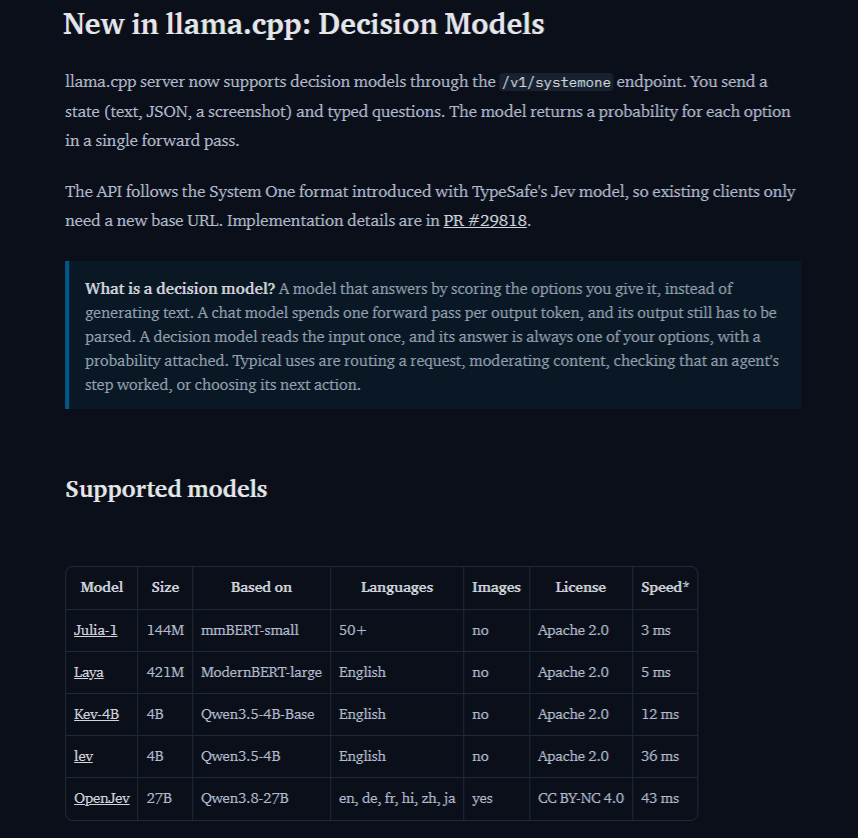
llama.cpp adds local decision-model support, including Laya

🎯 llama.cpp can now run decision models locally - update now. Give it a question and choices. Get probabilities back. No generated answer. Route requests, select tools, or check an agent’s work through the new /v1/systemone endpoint. GGUFs supported: → Julia-1: 144M → Laya, lev, Kev-4B → OpenJev: 27B, with image support OpenJev’s weights are CC BY-NC 4.0. The other four are Apache 2.0. Update llama.cpp to try it. 🔗 Link in ALT.

♥ 103↻ 175.2k viewsView on X

Posted a Laya demo on X? Mention “Laya” and it gets picked up automatically, or submit the project.