Demos, games, ports and benchmarks posted on X, picked by hand. Each one links back to the original post and, where there is one, to the project in the directory.
Ollama just got a new job
run decision models locally
Ollaya is basically bringing the Ollama idea to Jev-style decision models
text or JSON in
typed decision out
no token-by-token generation
Laya reports ~8–10ms for 5 questions on an RTX 4090
but here’s the catch
Jev’s API is already so cheap that I’ve been using it a lot and still haven’t burned through my $5
so local isn’t automatically better
the interesting part is that decision models are becoming something you can run, own and customize yourself
LLMs had their Ollama moment
decision models might be having theirs now
laya-mlx corre decisiones tipadas en MLX nativo sobre Apple Silicon: 13.4 ms median para una pregunta corta, 7.4 ms con el checkpoint multilingual, cero tokens de salida.
Clasifica preguntas locales (tipo "¿quién maneja este reembolso?") sin PyTorch ni API cloud.
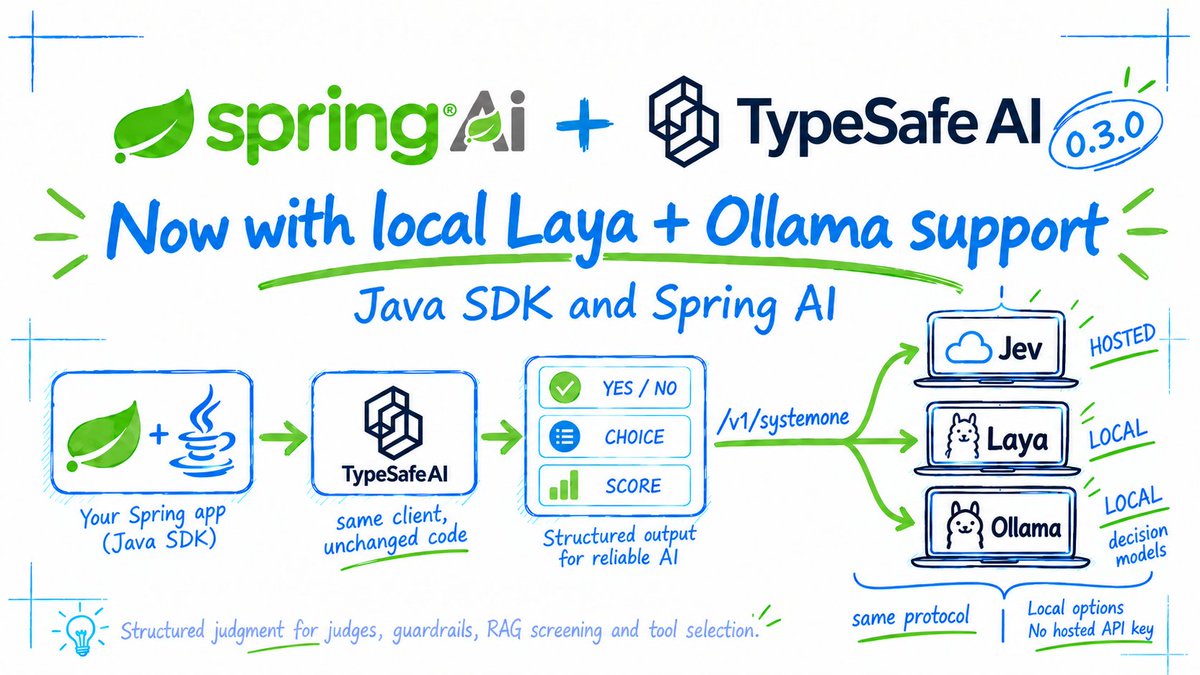
🚀 Spring AI TypeSafe 0.3.0 (@typesafeai Jev) now supports local engines too: the same client works with the Ollama and Laya #SystemOne endpoints
- Ollama:
- Laya:
#SpringAI #Ollama #Laya #Jev
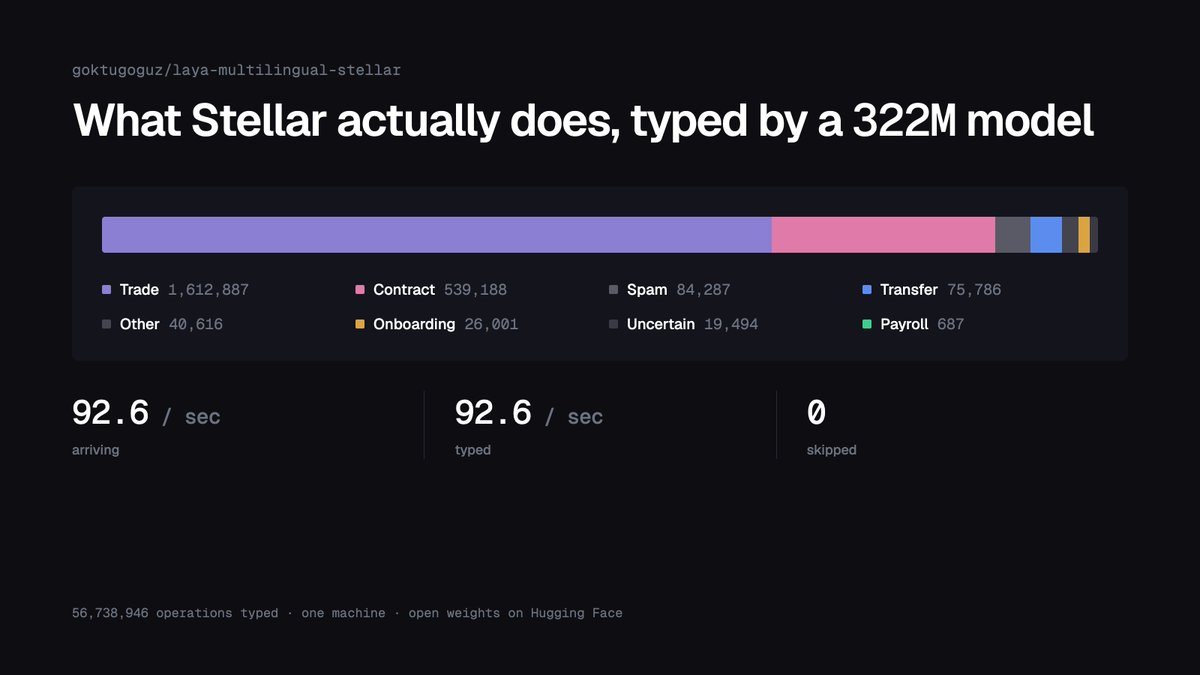
We fine-tuned Laya on Stellar.
If you're using Laya for anything on Stellar, try this before the base model. Open weights, same license.
It's already the model running Radar: 92.6 operations arriving per second, 92.6 typed per second, 0 skipped. One machine.
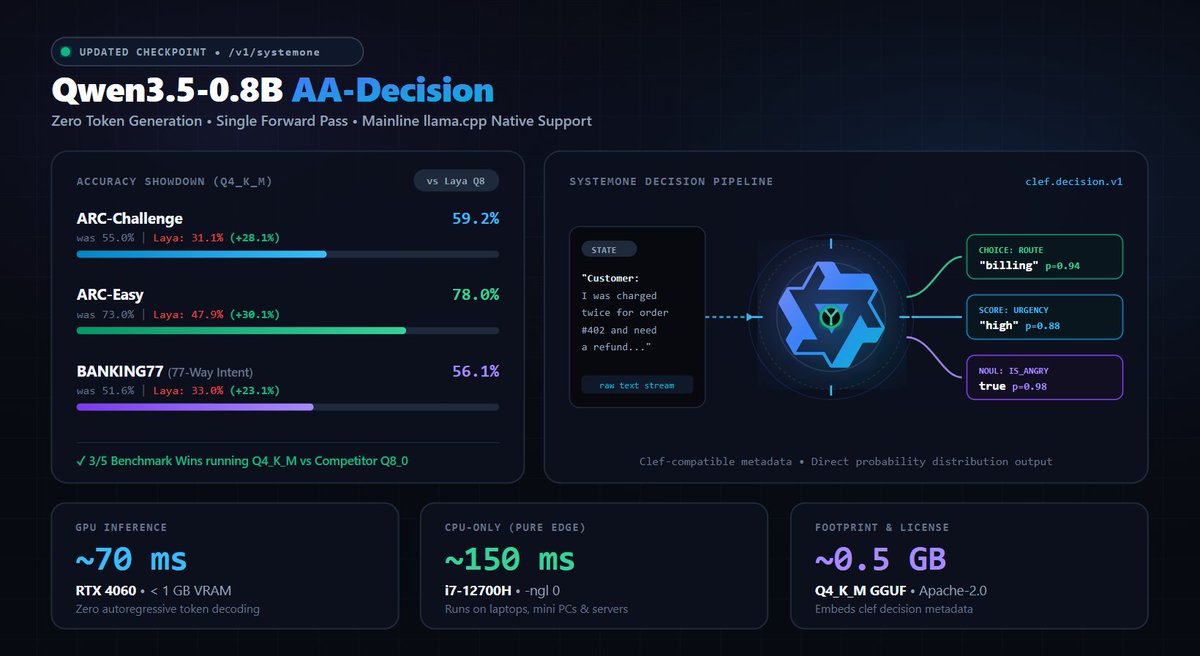
Decision model that runs on a CPU with 150 ms latency!
Cooked the 0.8B checkpoint a bit longer on a mix of typed-decisions + fast-decisions using @UnslothAI
The quality bump for a ~500MB model is wild:
- ARC-C: 55.0% ➔ 59.2% (Laya: 31.1%)
- ARC-E: 73.0% ➔ 78.0% (Laya: 47.9%)
- BANKING77: 51.6% ➔ 56.1% (Laya: 33.0%)
The real flex is the deployment footprint:
- RTX 4060: ~70ms, draws <1 GB VRAM
- Intel i7-12700H CPU only (-ngl 0): ~150ms
Still native /v1/systemone in llama.cpp.
one forward pass, zero autoregressive token overhead, typed answers out of the box.
Updated GGUF is live on Hugging Face (link in replies).
If you run this on a Raspberry Pi or Mac Mini, drop your latencies below.
Estuve jugando un poco con Laya y las primeras pruebas me dieron muy buenos resultados. Armé un pequeño firewall para detectar prompt injection y jailbreaks, corriendo todo local
Decision models are everywhere this week. The one I run on my Spark is Laya, an open 421M encoder, served through my arbiter repo.
One question: 20.9 ms
1 caller: 135 questions a second
32 callers at once: 301 questions a second
It sits next to the LLM in 5.1 GB. No text generated, just typed answers with a probability
I can imagine what we cannot build with ai. Nothing.
Check this out, someone just dropped a FREE open-source alternative to JEV that runs locally in ~30ms 😲
it’s called Laya.
→ doesn’t generate text, it just picks
→ give it an email with list of options and it tells you which one fits best
→ gives you full probabilities in one forward pass
→ train it on your own inbox and it can keep up on accuracy
→ Apache 2.0 and it runs completely offline
pretty wild for something this lightweight.
repo:
save this one for later.
OPENAI DOTS + OPUS 5.5 + SONNET 5.5 + GPT 6.1 SOL + GROKBOT + JEV + LAYA: ONE FOUNDER RAN A $1.2M A YEAR COMPANY ON 7 SEATS AND NO EMPLOYEES FOR $1,564.98 A MONTH
he stack costs $1,564.98 a month, and the 9 people it replaces cost $54,900
inbox → gate → build → write → check → ship
the sorter on Laya 421M tags every incoming message on the founder's laptop for $0.00, the gate on Jev 1.13 answers yes or no on 1.31M decisions for $19.78
the builder on GPT-6.1 Sol ships the changes for $612.40, the writer on Sonnet 5.5 writes the replies and the docs for $388.20
the operator, a Grokbot on Grok 4.6, runs the browser work inside a $200 plan, the checker on Opus 5.5 reads what touches money for $344.60
the seventh seat is a Dot on GPT-6 Astra that holds the inbox for $0.00 extra, the first dot comes with the plan
every seat is pinned: jev-1.13.0, gpt-6.1-sol, claude-sonnet-5-5, claude-opus-5-5, and none of the seven runs on “latest”
2,160 tasks a month, 72 a day, which is what 9 people close at 8 each
one task costs $25.42 with people and $0.725 with agents - that is 35x cheaper
and here is the most honest thing in this document: seven seats mean five vendors, four bills and three logins that can read each other's files, and one founder
the invoice is $1,564.98 a month, the attention is 61 hours a week, and 40 of those hours go to the jobs no seat is allowed to touch: pricing, signatures, apologies, firing customers
337 customers at $299 make $100,763 a month, $1,209,156 a year, and the stack takes 1.55% of it
seven seats, one signature
save this and paste it into Claude Code - let it staff your 7 seats for you ↓
This is NOT Jev.
Open source. Runs on your laptop. Makes decisions in ~27ms, about 200 times faster than waiting on a cloud-hosted LLM.
Here it is playing Tetris on its own:
A coding agent can write the right patch and still wreck the run with one tool call.
I built Gyra on Laya to check commands and tool output. In my frozen model-only audit: 29/30 hangs caught vs Laya English’s 0/30 at the same threshold.
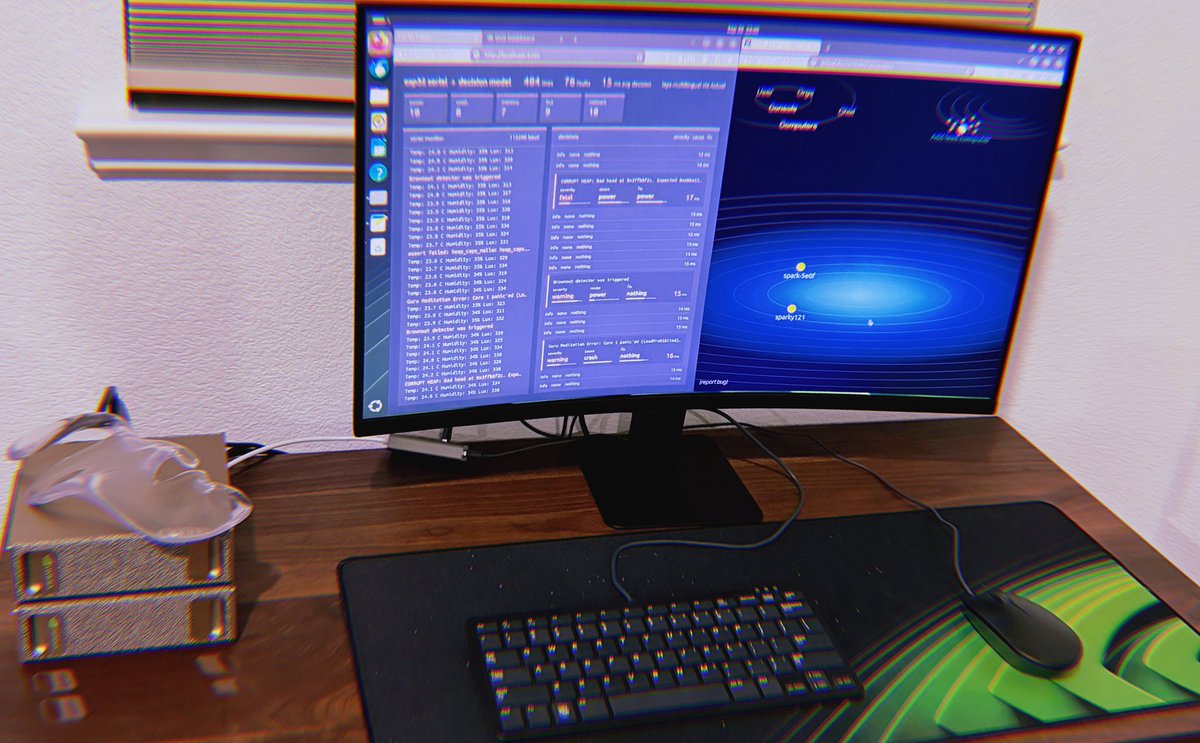
finally messing around with a decision model for the first time via @actualinc. this one is laya multilingual fp16, similar concept to jev, which has obviously popularized the idea recently. trying to test it with a labeling task on a fake esp32 serial feed.
New this week to Agent Wikis Pro: 6 custom skills, a video-generator specialist agent, and an exclusive video!
Skills:
-brand-identity-concepting
-generative-video-visual-qa
-identity-locked-generation
-portable-html-artifacts
-youtube-channel-production
-laya-fine-tuning
Specialist agent:
video-generator: a specialist agent that generates video locally with ComfyUI or in the cloud (always quoting the cost first), keeps characters consistent from shot to shot, checks every take, and assembles finished pieces in HyperFrames. Ships with 12 skills, 4 tools, 3 scheduled workflows and 4 ComfyUI templates.
Video:
Demo of the video generator agent, including making images and videos with local models, a cloud model, and then using Hyperframes to make a nice short video
Below is a short clip of that video, please subscribe to Agent Wikis Pro for the full video!
Laya on LiteRT now runs on the Qualcomm NPU. A decision encoder (Apache-2.0): a text and options in your words in, an answer with its probability out.
Clip: 5 questions on one email, Galaxy S26: GPU (FP32) 0.30 s, then NPU 0.18 s, timed by the app.
LAYA + SONNET 5.5 + OPUS 5.5 LABELED 2,000 TICKETS IN 1 HOUR, FINE-TUNED IN ONE AFTERNOON AND MOVED ACCURACY FROM 0.362 TO 0.766 FOR $51.05
the tuned sorter costs $51.05 once and $0.00 per ticket after, and a labeling agency charges $1.10 a ticket, $2,200 for the same 2,000
ticket → prelabel → audit → fine-tune → laya-typed-decisions → router
the prelabeler on Sonnet 5.5 labels 2,000 tickets for $5.60, the auditor on Opus 5.5 rechecks 400 of them for $36.00
the trainer, one rented GPU for 3 hours, costs $9.45, and the result is a local checkpoint that sorts at about 33 milliseconds a ticket
2,000 labels in 1 hour, and a person labels about 60 an hour
1 hour here is 33 hours of one person
one label costs $1.10 with an agency and $0.0255 with agents - that is 43x cheaper
and here is the honest part of this file: 0.766 means 1 ticket in 4 is still wrong, 23,400 misrouted out of every 100,000
and it holds only for tickets that look like the 2,000 you labeled, when you launch a new product line the accuracy drops until you label again
if 1% of the misrouted tickets are cancel requests, that is 234 customers at $299, $69,966 a month at risk
the model doubled its accuracy on the 2,000 you labeled, the 23,400 it still gets wrong are the ones you didn't think to label
save this and paste it into Claude Code - let it label your 2,000 tickets for you ↓
Acurast is running AI decisions directly on Android phones with Laya
In their System One demo, a model plays Tetris.
It looks at 5 possible moves, scores each one, and picks the best in about 0.2–1 second.
Tetris is just the test case. The same approach could power crypto agents that make decisions on their own without depending fully on centralized cloud providers.
There are billions of phones out there, and most of their computing power sits unused and they could become a part of the @Acurast architecture
Link to Try it in the comments.
A developer just shipped laya-mlx, a version of Laya that runs 50 times faster than Jev, entirely on-device.
laya-mlx runs Snake at 60 decisions per second, fully local, no cloud required.
It uses at most 1GB of memory. Laya is an open-source classification system similar to Jev, built on text output probabilities, and this version has been ported to MLX with additional performance optimizations layered on top.
In the demo, the model plays Snake on a local M3 Max at a decision speed of 60 times per second.
Here is the part that matters more than the speed number. A 1GB footprint means this can run on hardware that has no business running real-time inference, and a fully local classification model skips the latency and cost of a cloud round trip entirely. If open-source ports keep closing the gap on cloud models this fast, staying cloud-only gets harder to justify every month.
Intro to Jev, the new "System One model" from @typesafeai
What it is, why you should know about it, how is it different from regular Machine Learning, how is it different from LLMs, and why all the open source alternatives to Jev are not the same thing:
Laya playing pokemon Firered on my 3090 part 2:
26,000 steps later, we are now in Viridian forest.
But Bulbasaur is still level 5, no other pokemons and plenty of white outs.
So overnight session didn't go anywhere, looks like i need to tweek it more.
JEV vs Laya at @Tesla landing cars 👀
I had no idea DecisionOne models could self-balance falling cars lol
Rendering with @threejs and style inspired from @wheresryan22 's Anatomy skill
To make it fair, I'm running Laya using on a separate machine with an old RTX 2060S 8GB, wifi via slow USB adapter, LAN, using @mertcobanov ollaya.
Here's the repo: